
Commercial Robot Mowing Services in Appleton, WI
Robotic mowing technology is one of the fastest-growing trends in commercial landscape maintenance. Manufacturers promise reduced labor requirements, consistent cutting, lower operating costs, and autonomous operation.
The technology is advancing rapidly, and landscape contractors across the country are testing where robotic mowing can fit into their operations. At Lowney’s Landscaping, we’ve begun deploying robotic mowers in select commercial applications throughout Northeast Wisconsin.
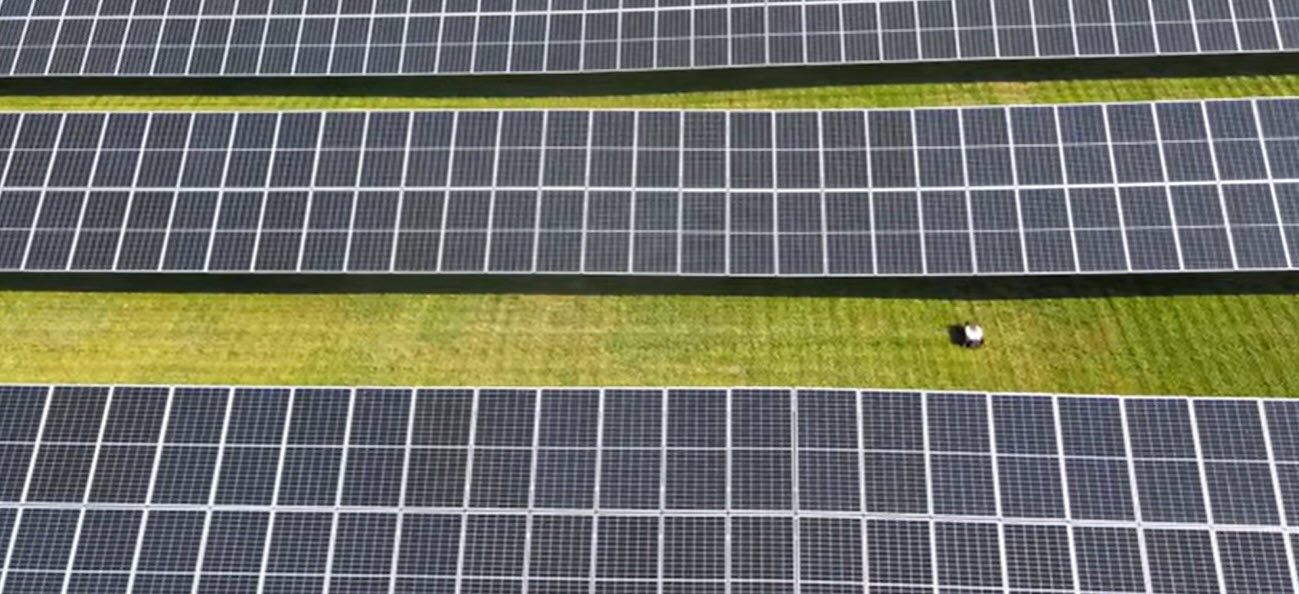
For instance, one of the most successful uses so far has been mowing beneath solar panels – areas that can be difficult, time-consuming, and sometimes impractical for traditional mowing equipment to navigate efficiently.
What we’ve discovered, however, is that robotic mowing is neither a gimmick nor a complete replacement for traditional commercial mowing. Like most new technologies, it works exceptionally well in some situations and struggles in others.
Thick Turf Remains a Challenge
One of the biggest lessons has been that robotic mowers perform best when conditions remain consistent.
“We’re learning pretty quickly that thick turf can be a challenge for some of these machines,” says Brent, a Commercial Maintenance Consultant with Lowney’s Landscaping. “Dense, lush turf has been one of the biggest eye-openers for us. When grass becomes especially thick and vigorous, some robotic mowers don’t process through it nearly as efficiently as a commercial mower with an experienced operator.”
Rather than viewing that as a setback, Brent sees it as part of the learning process.
“That’s exactly why we’re testing these machines in the real world,” he says. “Every property teaches us something. We’re learning where the robots shine, where they struggle, and how to match the right machine to the right environment.”
Not All Robot Mowers Are Created Equal
A common misconception is that robotic mowers are essentially interchangeable. In reality, the differences between models can be substantial, and the different sizes and purposes can vary a lot.
“People hear ‘robot mower’ and assume they’re all the same, but that’s definitely not what we’re seeing,” Brent says. “Some of the larger units are designed for huge open areas. The problem is that when we compare them to a commercial stand-on mower with a skilled operator, the traditional equipment is often still faster and more efficient.”
On the other hand, Brent says some of the smaller robotic units are very helpful in situations like the solar panels mentioned earlier.
“The smaller robots have actually been some of our favorites because they can get into places that aren’t ideal for larger equipment,” he says. “Areas around solar panels, courtyards, slopes, ditches, fenced spaces, and other tight locations are where we’re seeing some of the biggest advantages.”
The result has been a more selective deployment strategy. “We’re not trying to force robots into every application,” Brent says. “We’re trying to find the applications where they genuinely make sense.”
An Unexpected Benefit: Less Noise
One advantage that doesn’t always appear in manufacturer marketing materials is noise reduction. “At [one of the corporate locations], we used to send a 42-inch gasoline mower into a small courtyard every Monday morning,” Brent says. “Residents would hear that engine running throughout the area. Today, a robotic mower handles most of that work, and the loudest machine in the courtyard is only a battery-powered string trimmer.”
For senior living communities, healthcare facilities, apartment complexes, and other properties where noise matters, that reduction can be a meaningful benefit beyond labor savings or efficiency.
Can Robot Mowers Run at Night?
One advantage often promoted by manufacturers is the ability to operate robotic mowers around the clock. In theory, a commercial property could have its turf maintained overnight while employees, customers, or visitors are absent. In practice, that capability still has limitations.
“A lot of people assume these things are perfect for overnight mowing, and that hasn’t really been our experience so far,” Brent says. “At the end of the day, they’re still relying on cameras, sensors, and navigation systems. Those systems perform better when they can see what they’re doing.”
While nighttime operation remains possible, Brent believes the technology still has room to mature. “I think future generations are going to get significantly better,” he says. “The technology is improving incredibly fast. But if you’re asking me today whether I’d rather have a robot mowing during daylight hours or overnight, I’m picking daylight every time.”
Can My Company Buy a Robot Mower Instead of Hiring a Commercial Mowing Service?
Perhaps the biggest lesson from the team’s early adoption is that robotic mowing should not be viewed as a replacement for commercial mowing professionals. Instead, it is becoming another tool available to them. “I don’t think the future is robots replacing lawn care crews,” Brent says. “I think the future is lawn care professionals learning how to use robots effectively.”
He compares the technology to many other innovations that have entered the green industry over the years. “Every major advancement starts with people making mistakes, learning lessons, and figuring out where the technology fits,” Brent says. “We’re in that stage right now. The exciting part is that we’re already seeing situations where robotic mowing solves problems that were difficult to solve before.”
For now, robotic mowers appear to be finding their place as a specialized tool within commercial landscape maintenance programs rather than a wholesale replacement for commercial mowing crews. “The robots are going to keep getting better,” Brent says. “But so are the people using them. That’s really the story. The technology is impressive, but it’s the experience behind it that ultimately determines whether it succeeds.”
The future of commercial mowing will almost certainly include robots. The question isn’t whether they’ll become part of the industry. It’s where they’ll provide the most value. Based on what we’re seeing in the field today, that answer is becoming clearer with every acre we mow.
Tags: